

Barrier
We are a professional manufacture specializing in the production of various metal wire mesh. With years of abundant export experience, we are dedicated to providing outstanding OEM/ODM services to customers worldwide, catering to their customized needs. Our products have always adhered to the highest quality standards and undergo rigorous testing, including the Australian Shear Testing AS5039-2008 and salt spray tests, to ensure the reliability and durability.
-
![Industrial And Energy Facility Noise Barriers]() Industrial And Energy Facility Noise BarriersNoise barriers for industrial and energy installations, including power plant noise barriers and cooling tower noise barriers, designed to include noise panels and generator noise barriers. These...read more
Industrial And Energy Facility Noise BarriersNoise barriers for industrial and energy installations, including power plant noise barriers and cooling tower noise barriers, designed to include noise panels and generator noise barriers. These...read more -
![Urban And Community Noise Barriers]() Urban And Community Noise BarriersUrban and Community Noise Barriers, including Community Municipal Barriers, Urban Landscape Barriers, and Totally Closed Barriers, form an integral part of city infrastructure. These barriers...read more
Urban And Community Noise BarriersUrban and Community Noise Barriers, including Community Municipal Barriers, Urban Landscape Barriers, and Totally Closed Barriers, form an integral part of city infrastructure. These barriers...read more -
![Transportation Infrastructure Noise Barriers]() Transportation Infrastructure Noise BarriersTransportation Infrastructure Noise Barriers, encompassing highway traffic, railway, and bridge noise barriers, are designed as sound absorbing and sound proof barriers. These critical structures...read more
Transportation Infrastructure Noise BarriersTransportation Infrastructure Noise Barriers, encompassing highway traffic, railway, and bridge noise barriers, are designed as sound absorbing and sound proof barriers. These critical structures...read more


Why choose us
OEM/ODM Service
Short production time, sufficient inventory of raw materials, production capacity of 800,000 ㎡per year, pre-sale - sale - after-sale services are equipped with professional team.
100% Quality Control
The whole process is 10 processes, and 10 quality inspection processes are strictly set up to achieve 100% quality inspection of the whole process.
Certificates and Standard
Our 304&316 Marine Grade Stainless Steel Mesh is able to pass the Australian Standard Knife Shear tests:AS5039-2008 and Salt Spray Test.
All Types of Solutions
Our high tensile screens can better provide safe solutions for your products,security protection, pest prevention, impact resistance, child protection, UV blockage.
Barrier Specifications
|
Parts list |
Items |
Product description |
|
Noise barrier panel |
Metal material |
Galvanized sheet aluminum alloy sheet, color plate |
|
Transparent material |
Glass, PC board, acrylic board, etc. |
|
|
Other material |
High strength cement, cement wood chips, glass steel, etc. |
|
|
Hole pattern |
Louver holes; Common hole spacing 20*137, 20*182 |
|
|
Micropores; Common 3 holes 3 distances, 5holes 2 distances, 2 holes 4 distances |
||
|
Aperture ratio |
Not less than 25% |
|
|
Common size |
500*2000*80(100) mm,500*2000*120 mm,1000*2000*80(100) mm etc. |
|
|
Surface concave groove |
Can be customized according to drawings or customer requirements |
|
|
Surface treatment |
Electrostatic powder coating, fluorocarbon spraying |
|
|
Color |
Green 6029, blue5017, gray7042, white 9010, etc. color can be selected according to the national standard color card |
|
|
H shape post |
Material |
Q235B |
|
Common size |
100*100*6*8 125*125*6.5*9 150*150*7*10 175*175*735*11 etc. |
|
|
Common height |
2m-6m up to12m |
|
|
Flange |
Size tolerance less than 2mm, thickness tolerance less than 0.4mm |
|
|
Long hole:22*30 24*30 26*40 28*40; Round hole:22 24 26 28 30 35 |
||
|
Surface treatment |
Hot dip galvanizing-electrostatic powder coating, fluorocarbon spraying |
|
|
Color |
Green 6029, blue5017, gray7042, white 9010, etc. color can be selected according to the national standard color card |
|
|
Noise absorb material |
Glass wool, rock wool, water-repellent, cloth, acoustic felt, foam aluminum fiber etc. |
|
Key Features
Recyclability
After a noise barrier's job is done, it can be recycled to help the environment. Noise barriers that are made from a single material are easier to recycle.
Sound absorption
Noise barriers are built with materials that can absorb sound. This helps to reduce the amount of noise that reaches homes and other places.
Reflective surfaces
Some barriers have smooth, hard surfaces that reflect sound waves back towards the source of the noise. This can help to decrease noise levels for people living nearby.
Sealing capabilities
Good quality noise barriers fit tightly against the ground and other surfaces. This prevents gaps where sound could travel through.
Types of Barriers Available
Transparent barriers
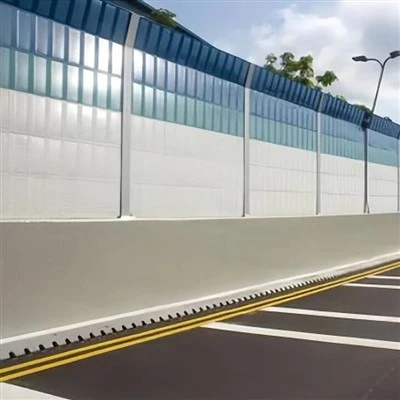
Transparent barriers are noise walls constructed using transparent materials like acrylic or polycarbonate panels. They allow for visibility while still providing sound attenuation.
Earth berms
Earth berms are mounds of soil and vegetation strategically located between noise sources and receptors. They are a cost-effective way to reduce noise pollution.
Composite barriers
Composite barriers integrate materials with varying acoustic properties, like concrete and wood or metal and vegetation. The goal is to create a structure that efficiently blocks sound while being aesthetically appealing.
Mass barriers
Mass barriers are heavy walls made of materials with high-density noise-canceling capabilities. They can be solid or have a double wall. Mass barriers block sound transmission through the principles of sound physics.
Applications
Urban Areas
In cities, noise barriers can be walls or fences that block sounds from cars, construction and airplanes. They protect residential neighborhoods from urban noise pollution.
Industrial Sites
Factories and plants often use large walls or structures to contain their own machinery and operation sounds. This is especially true if they are located near homes or commercial areas.
Airports
Noise barriers such as walls, mounds or other formations are placed near runways and flight paths. They help shield nearby neighborhoods from loud airplane sounds.
Railways
Similar to roadways, noise barriers like walls or earth mounds are positioned near train tracks. They protect nearby buildings and residents from loud train sounds.
Shipping
We process all orders within 1 to 2 business days. Orders received after 12 p.m. EST will fall on the next business day. All stock items will be shipped FedEx ground (no signature required) within 1 to 2 business days regardless of the shipping option, either ground or 2nd day, next day, or overnight.We offers shipping services via UPS & USPS.
Our Certificate

FAQ
As one of the leading barrier manufacturers and suppliers in China, we warmly welcome you to buy customized barrier at competitive price from our factory. Contact us for free sample.
steel wire mesh systems, mesh screen facade